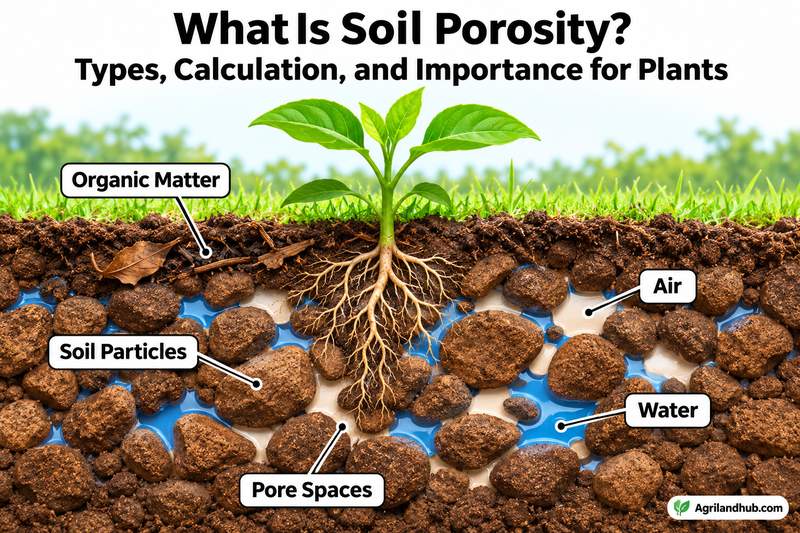
Soil is more than a collection of mineral particles, organic matter, and nutrients. Between these particles, there are small and large spaces known as pores, which play an essential role in determining how water, air, and nutrients move through the soil.
These spaces are directly related to soil porosity, one of the most important physical properties affecting plant growth and soil health.
Good soil porosity allows roots to obtain sufficient oxygen, absorb water, access nutrients, and grow without excessive physical resistance. In contrast, poorly structured soil with inadequate pore space can cause waterlogging, limited aeration, restricted root development, and reduced agricultural productivity.
Understanding what soil porosity is, its different types, how to calculate it, and its importance for plants can help farmers, gardeners, and agricultural professionals manage soil more effectively.
What Is Soil Porosity?
Soil porosity is the proportion of the total soil volume that consists of empty spaces or pores between soil particles and aggregates. These pores may contain air or water, depending on soil moisture conditions.
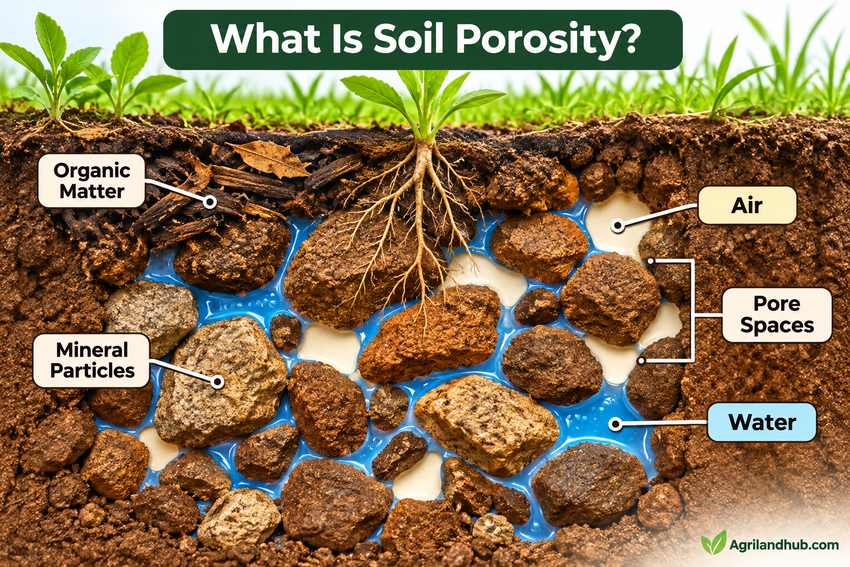
In simple terms, soil porosity describes how much empty space exists within a particular volume of soil.
For example, imagine a soil sample with a total volume of 100 cubic centimeters. If 45 cubic centimeters consist of pore spaces, the soil has a total porosity of 45%.
Soil pores are essential because they provide pathways for several important processes, including:
- Water infiltration into the soil.
- Movement of water between soil layers.
- Storage of water for plant uptake.
- Exchange of oxygen and carbon dioxide.
- Root penetration and development.
- Movement of soil microorganisms and dissolved nutrients.
Soil porosity is closely connected to other soil physical properties, including bulk density, particle density, soil texture, soil structure, and soil aggregation.
However, soil porosity should not be confused with soil permeability. Porosity measures the amount of pore space, while permeability describes how easily water or air moves through connected pores.
A soil may have relatively high total porosity but still have poor water movement if many of its pores are small or poorly connected.
Why Is Soil Porosity Important?
Soil porosity influences several processes that determine whether plants can grow properly. It affects the availability of water and oxygen, the movement of nutrients, and the physical conditions surrounding plant roots.
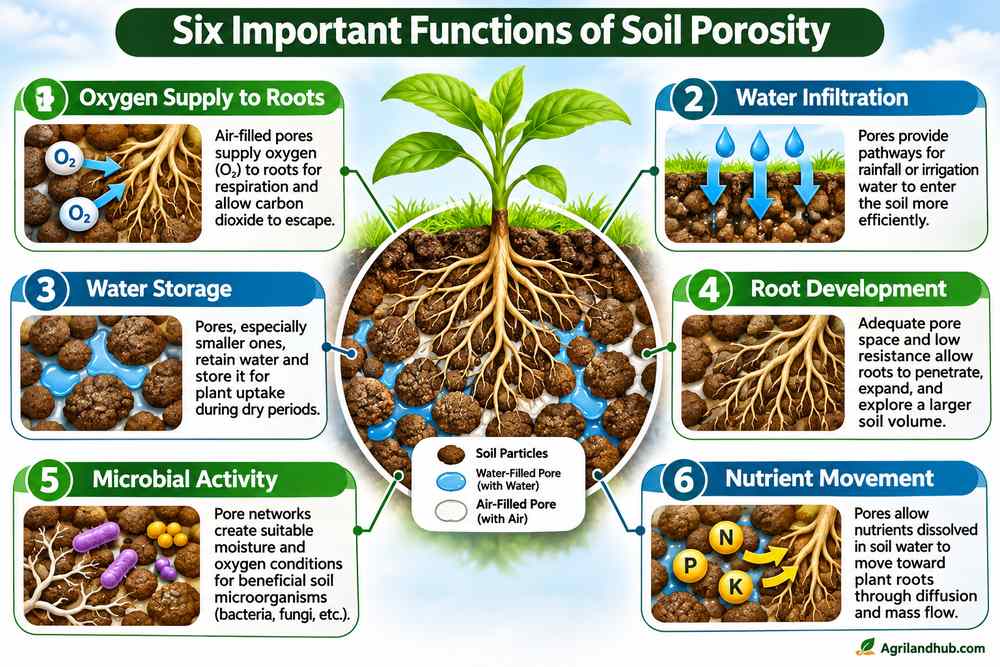
1. Provides Oxygen for Plant Roots
Plant roots need oxygen for cellular respiration, the process through which they release energy for growth and nutrient absorption.
Air-filled pores allow oxygen to move from the atmosphere into the soil. They also provide pathways for carbon dioxide produced by roots and microorganisms to escape.
When soil becomes compacted or waterlogged, many pores become filled with water. Because oxygen moves much more slowly through water than through air, root respiration may become restricted.
Prolonged oxygen deficiency can cause root damage, reduced nutrient uptake, and poor plant development.
2. Improves Water Infiltration
Water infiltration is the process by which water enters the soil surface.
Well-structured soil with connected pores generally allows rainfall and irrigation water to enter more efficiently.
Good infiltration can help reduce surface runoff, erosion, and water accumulation.
However, infiltration does not depend on total porosity alone. Surface crusting, soil compaction, pore connectivity, and soil moisture conditions also influence infiltration rates.
3. Supports Water Storage
Soil pores act as temporary storage spaces for water.
Small pores can retain water through capillary forces, while larger pores generally drain more quickly under gravity.
The ability of soil to retain water is important because plants need a continuous water supply for photosynthesis, nutrient transport, and other physiological processes.
Soils with an appropriate distribution of pore sizes can provide both drainage and water availability.
4. Supports Root Growth
Roots need sufficient space to extend through the soil and explore a larger volume for water and nutrients.
Soil with suitable pore distribution and low mechanical resistance allows roots to penetrate more easily.
In compacted soils, large pores may collapse, increasing soil strength and restricting root development.
This can result in shallow root systems and reduced access to water and nutrients.
5. Supports Soil Microorganisms
Soil contains numerous microorganisms, including bacteria, fungi, and other organisms that contribute to nutrient cycling and organic matter decomposition.
These organisms depend on suitable moisture and oxygen conditions.
Well-aerated soil provides favorable environments for many aerobic microorganisms, while waterlogged conditions may favor anaerobic processes.
Healthy pore networks help maintain the physical environment required for diverse soil biological activities.
6. Helps Maintain Soil Fertility
Soil porosity indirectly supports soil fertility by influencing water availability, nutrient movement, oxygen supply, and microbial activity.
For example, nutrients dissolved in soil water can move toward plant roots through diffusion and mass flow.
When soil structure deteriorates, water movement and root access may become restricted, making nutrient uptake less efficient.
Types of Soil Porosity
Soil porosity can be classified according to pore size, origin, and function. One of the most widely used classifications in soil science is based on pore diameter.
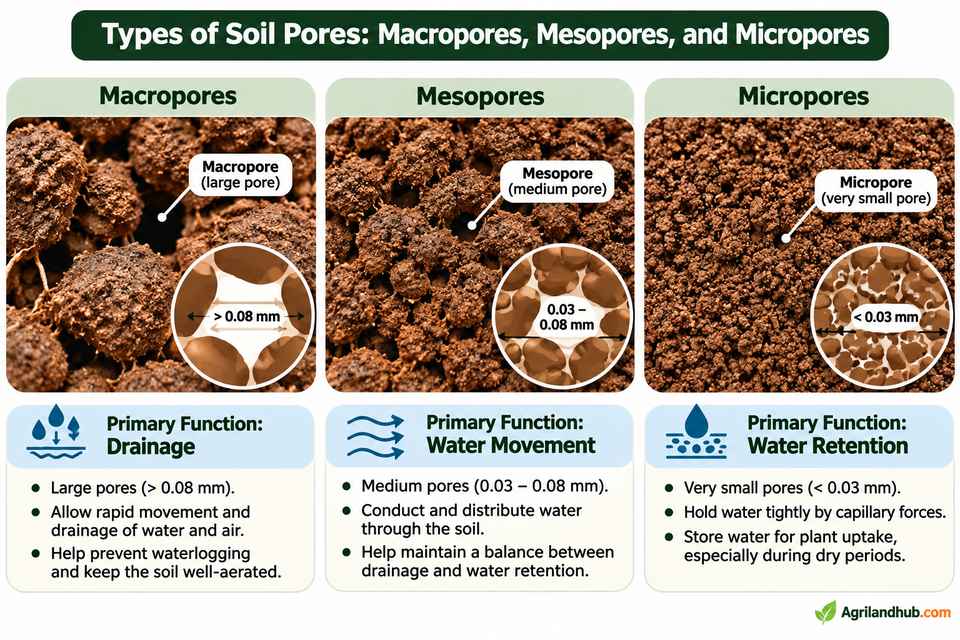
The two broad categories commonly discussed are macroporosity and microporosity. Mesoporosity is also used in classifications that divide pores into three size groups.
1. Macroporosity
Macroporosity refers to the larger pores in soil. These pores are commonly formed between soil aggregates, around roots, and through biological activity.
Macropores are important for:
- Rapid water drainage.
- Air circulation.
- Oxygen exchange.
- Root penetration.
- Movement of water through the soil profile.
Macropores usually drain relatively quickly after rainfall or irrigation.
Earthworm channels, old root channels, and cracks in certain soils are examples of structures that can create macropores.
Soils with sufficient macroporosity generally have better aeration and drainage, provided that the pores are connected.
2. Microporosity
Microporosity refers to smaller pores that retain water more strongly through capillary forces.
These pores are particularly important for water storage.
Some water retained in micropores remains available for plant uptake, although extremely small pores may hold water too tightly for roots to extract.
Microporosity is often relatively high in fine-textured soils, particularly clay-rich soils.
Important characteristics include:
- Greater water retention.
- Slower drainage.
- Reduced air movement when pores are water-filled.
- Strong influence on soil moisture availability.
A soil with high microporosity may store considerable water but can experience poor aeration when excessively wet.
3. Mesoporosity
Mesoporosity describes intermediate-sized pores between macropores and micropores in three-category classification systems.
These pores play an important role in storing and transmitting water.
They can retain water while still allowing some movement through the soil.
Mesopores are therefore important for balancing water availability and drainage.
4. Biological Pores
Biological pores are spaces formed by living organisms and biological processes.
Examples include:
- Earthworm burrows.
- Insect tunnels.
- Decayed root channels.
- Fungal pathways.
- Spaces created by decomposing organic matter.
Biological pores can improve soil aeration, infiltration, drainage, and root penetration.
Their presence is often associated with healthy soil biological activity.
5. Structural Pores
Structural pores develop through the arrangement and aggregation of soil particles.
They occur between and within soil aggregates.
Stable soil aggregates can create a connected network of pores that supports water infiltration, air circulation, and root development.
Soil management practices that preserve aggregation can help maintain favorable structural porosity.
Factors Affecting Soil Porosity
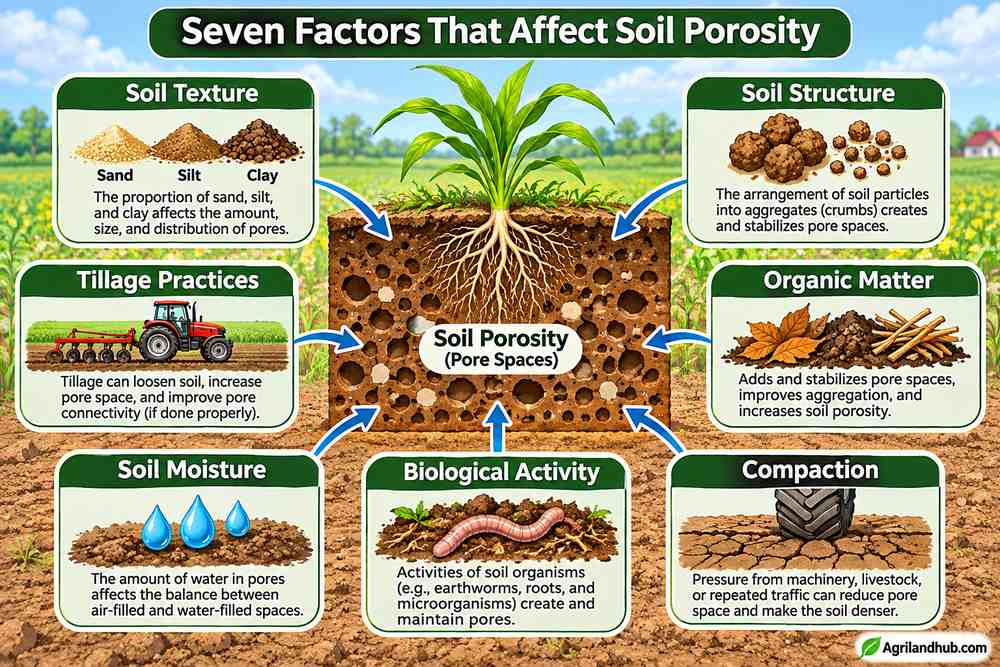
Soil porosity is influenced by several physical, chemical, and biological factors. These factors determine the number, size, distribution, and connectivity of pores within the soil.
1. Soil Texture
Soil texture refers to the relative proportions of sand, silt, and clay particles.
Different soil textures have different pore-size distributions.
Sandy soil
Sandy soil contains relatively large particles and generally has larger pores between individual particles. However, the total pore volume may be lower than in clay soil.
Characteristics:
- Relatively rapid drainage.
- Good air circulation when not compacted.
- Lower water retention.
- Greater potential for nutrient leaching.
Clay soil
Clay soil contains very small particles and often has a relatively high total pore volume.
Characteristics:
- High water retention.
- Relatively slow drainage.
- Greater potential for waterlogging.
- May have poor aeration when wet.
Loamy soil
Loamy soil contains a balanced mixture of sand, silt, and clay.
It can provide a favorable combination of water retention, drainage, and aeration when its structure is well developed.
2. Soil Structure
Soil structure describes how individual soil particles are arranged into aggregates.
Well-aggregated soil generally contains a combination of large and small pores.
Granular and crumb structures are often favorable for agricultural topsoil because they support water infiltration, air exchange, and root growth.
Poorly structured soil may have fewer continuous pores and greater resistance to root penetration.
3. Organic Matter Content
Organic matter plays an important role in maintaining soil structure.
Decomposed plant residues, compost, manure, and other organic materials can contribute to aggregate formation and stability.
Organic matter can improve soil porosity through several mechanisms:
- Encouraging soil aggregation.
- Supporting microbial activity.
- Providing energy for soil organisms.
- Promoting biological pore formation.
- Reducing the risk of structural degradation.
Adding organic matter is therefore an important practice for maintaining healthy agricultural soil.
4. Soil Compaction
Soil compaction occurs when soil particles are pressed closer together, reducing pore space.
Common causes include:
- Heavy agricultural machinery.
- Repeated vehicle movement.
- Livestock trampling.
- Excessive tillage.
- Working soil when it is too wet.
- Repeated foot traffic.
Compaction can reduce macroporosity, restrict water movement, and increase mechanical resistance to roots.
5. Biological Activity
Earthworms, insects, fungi, and plant roots contribute to the development and maintenance of soil pores.
Earthworms create channels as they move through the soil, while plant roots can create pathways that remain after roots decompose.
These biological activities help improve pore connectivity and soil structure.
6. Soil Moisture
Soil moisture affects how pores are occupied by water and air.
When soil is saturated, most accessible pore spaces are filled with water. As water drains, larger pores generally become filled with air first.
This change affects oxygen availability and root respiration.
7. Tillage and Agricultural Practices
Agricultural management can either improve or damage soil porosity.
Appropriate tillage may temporarily loosen compacted surface soil. However, intensive and repeated tillage can destroy aggregates and contribute to structural instability.
Conservation agriculture, cover cropping, residue retention, and controlled machinery traffic can help maintain soil pore networks over time.
How to Calculate Soil Porosity
Soil porosity can be calculated using the relationship between bulk density and particle density.
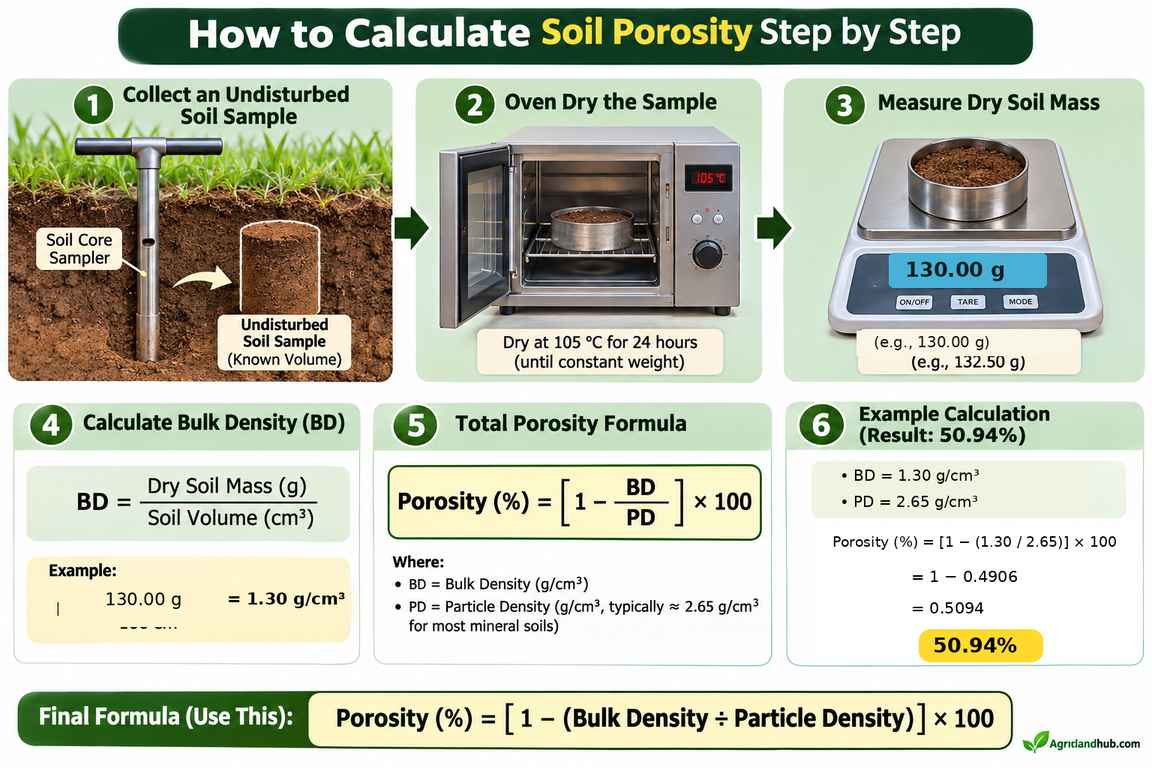
The result represents the percentage of the total soil volume occupied by pore spaces.
1. Soil Porosity Formula
The standard formula for calculating total soil porosity is:
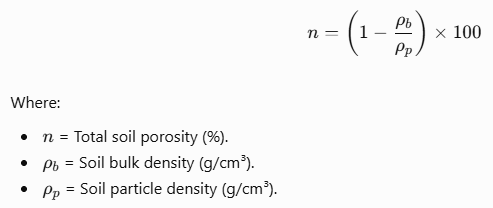
Bulk density represents the mass of oven-dry soil divided by the total soil volume, including pore spaces.
Particle density represents the mass of oven-dry soil divided by the volume occupied by soil solids only.
For many mineral soils, particle density is commonly estimated at 2.65 g/cm³. However, actual values can differ depending on mineral composition and organic matter content.
2. Example of Soil Porosity Calculation
Suppose a soil sample has the following properties:
| Parameter | Value |
|---|---|
| Bulk density | 1.30 g/cm³ |
| Particle density | 2.65 g/cm³ |
| Total soil volume | 100 cm³ |
Using the formula:
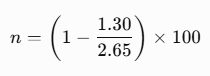
First, divide bulk density by particle density:
1.30/2.65=0.4906
Next, subtract the result from 1:
1-0.4906=0.5094
Finally, multiply by 100:
0.5094/100=50.94%
The total soil porosity is approximately 50.94%.
This means that approximately 50.94% of the total soil volume consists of pore spaces, while the remaining 49.06% consists of solid materials.
3. Another Example: Comparing Two Soil Samples
Consider two soil samples with different bulk densities.
| Parameter | Sample A | Sample B |
|---|---|---|
| Bulk density | 1.20 | 1.60 |
| Particle density | 2.65 | 2.65 |
| Total porosity | 54.72% | 39.62% |
The calculations are:
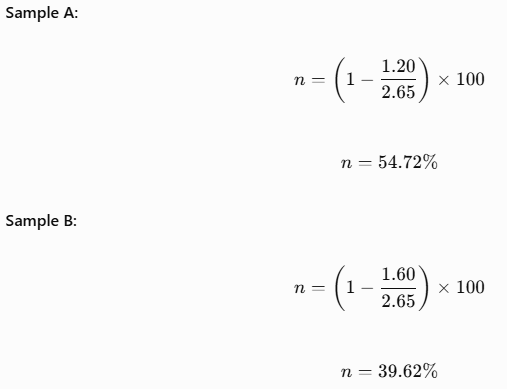
The comparison indicates that Sample A has a greater proportion of pore space than Sample B.
If both samples have similar texture and particle composition, the higher bulk density of Sample B may indicate greater compaction.
However, porosity alone does not establish whether a soil is suitable for a particular crop. Pore-size distribution, connectivity, water availability, and mechanical resistance must also be considered.
4. Calculating Porosity Using Pore Volume
Another method is to calculate porosity directly from the volume of pore spaces and total soil volume.
The formula is:
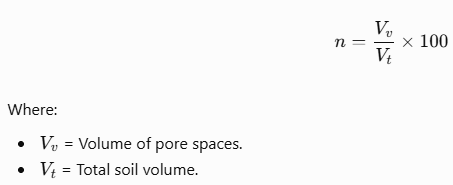
For example:
A soil sample has a total volume of 200 cm³, with a pore volume of 90 cm³.
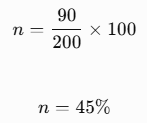
Therefore, the soil porosity is 45%.
This approach is useful when pore volume and total sample volume are known.
5. How to Measure Bulk Density
Bulk density is commonly measured using an undisturbed soil core.
The basic procedure is:
- Prepare a cylindrical soil core sampler with a known volume.
- Insert the sampler into the soil without disturbing the sample as much as possible.
- Carefully remove the sampler containing the soil.
- Trim excess soil from both ends.
- Transfer the sample into a container.
- Dry the soil in an oven, commonly at approximately 105°C until constant mass.
- Weigh the dry soil.
- Divide the dry soil mass by the original total core volume.
The formula is:
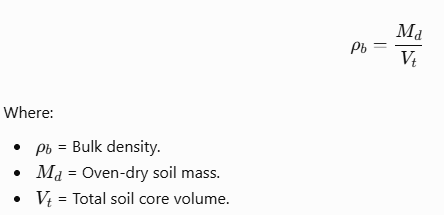
For example, if the oven-dry soil mass is 130 grams and the core volume is 100 cm³:
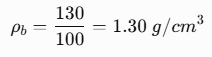
The bulk density is 1.30 g/cm³.
6. Important Considerations When Calculating Porosity
To obtain reliable results, several factors should be considered:
- Collect samples from representative locations.
- Avoid disturbing the soil structure during sampling.
- Use the correct core volume.
- Ensure the sample is completely dry before weighing.
- Use an appropriate particle density value.
- Take samples from different soil depths when necessary.
- Conduct multiple measurements to improve reliability.
It is also important to remember that calculating porosity from bulk density and particle density provides total porosity, not the separate proportions of macropores and micropores.
What Is the Ideal Soil Porosity for Plant Growth?
Soil porosity varies according to soil texture, structure, organic matter, and management practices.
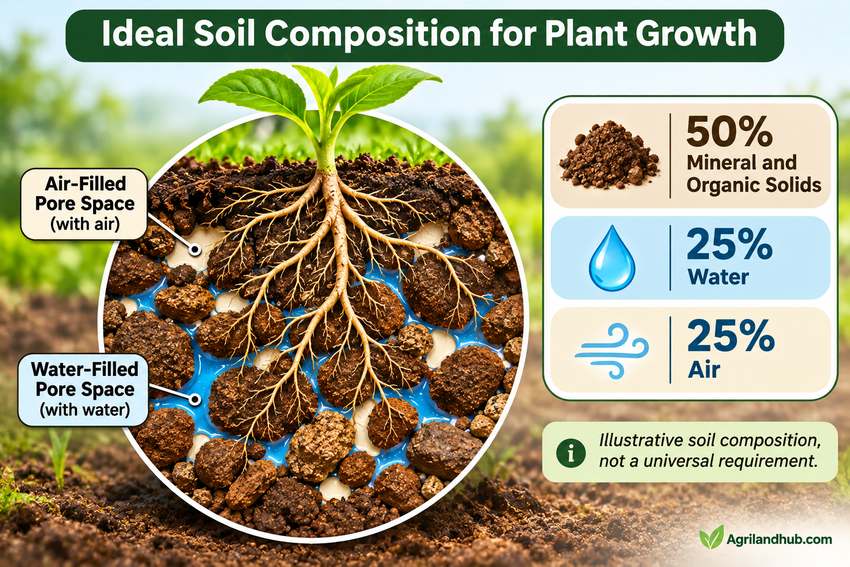
A total porosity of approximately 50% is often used as a general reference for well-balanced mineral agricultural soil.
This approximate value represents a soil volume consisting of:
- 50% solid materials.
- 50% pore spaces.
However, 50% should not be treated as a universal target for every soil or crop.
Some clay soils naturally have higher total porosity, while sandy soils may have lower total porosity but larger average pores.
The distribution of pore sizes is often more important for plant growth than the total porosity percentage alone.
1. Total Porosity and Air-Filled Porosity
Total porosity represents all the spaces that may contain air or water.
Air-filled porosity represents the proportion of soil volume occupied by air at a particular moisture condition.
The relationship can be expressed as:
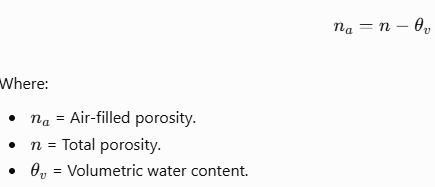
For example:
If total porosity is 50% and volumetric water content is 30%, then:

The soil has 20% air-filled porosity.
This distinction is important because a soil may have high total porosity but insufficient air-filled pore space when saturated.
2. Why Air-Filled Porosity Matters
Plant roots require oxygen to maintain normal metabolic activity.
When the proportion of air-filled pores becomes too small, oxygen diffusion may become insufficient to support healthy root respiration.
The appropriate air-filled porosity depends on soil conditions, crop species, and environmental factors. As a practical reference, some soil management guidance recommends maintaining at least approximately 10% air-filled porosity, although this is not a universal threshold.
Differences in Soil Porosity Based on Soil Texture
Soil texture influences both total porosity and pore-size distribution.
Understanding these differences helps farmers determine appropriate soil management practices.
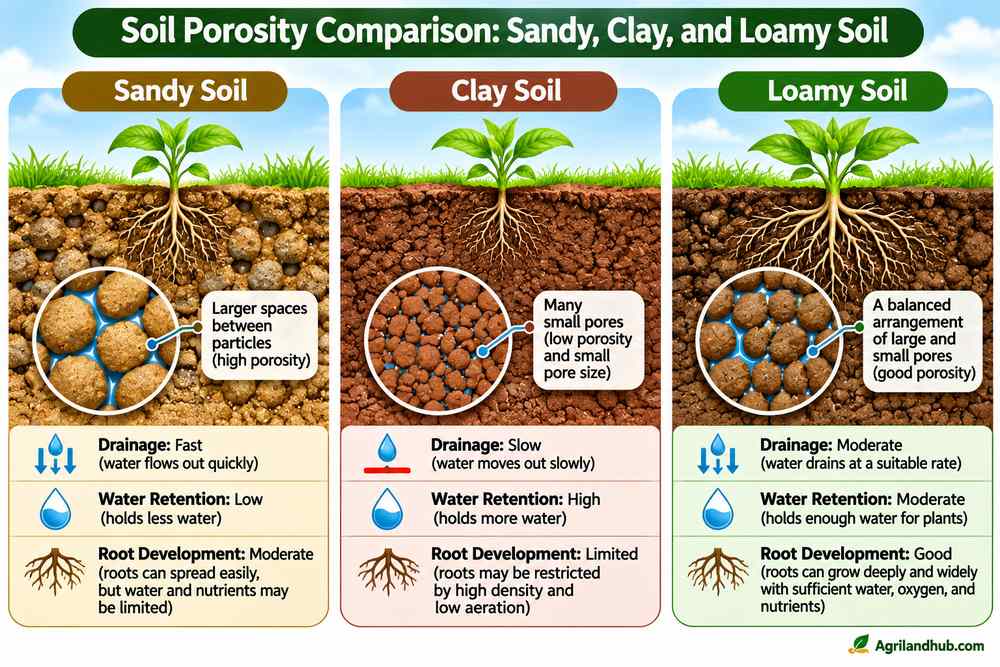
1. Sandy Soil Porosity
Sandy soils contain relatively large particles.
Their pore spaces are generally larger, allowing water to drain rapidly.
However, sandy soils often have lower water retention because gravity drains much of the water through their larger pores.
Management recommendations:
- Add mature compost.
- Use organic mulch.
- Apply irrigation according to crop requirements.
- Maintain plant cover.
- Minimize unnecessary soil disturbance.
2. Clay Soil Porosity
Clay soils contain very fine particles and commonly have many small pores.
These soils can retain large quantities of water, but drainage and aeration may be restricted depending on their structure.
Management recommendations:
- Avoid machinery traffic when the soil is wet.
- Improve organic matter content.
- Maintain suitable drainage.
- Use cover crops.
- Avoid excessive tillage.
3. Loamy Soil Porosity
Loamy soil often provides a favorable combination of pore sizes.
It can hold enough water for plant growth while allowing excess water to drain.
Management recommendations:
- Maintain organic matter.
- Practice crop rotation.
- Protect soil aggregates.
- Reduce unnecessary compaction.
- Maintain suitable soil moisture.
| Soil type | General pore characteristics | Water retention | Drainage |
|---|---|---|---|
| Sandy | Larger pores | Low | Fast |
| Clay | More small pores | High | Often slow |
| Loam | Balanced pore distribution | Moderate to high | Moderate to good |
These are general tendencies. Actual soil behavior depends on aggregation, organic matter, compaction, and pore connectivity.
How to Improve Soil Porosity
Improving soil porosity requires management practices that maintain soil aggregation, encourage biological activity, and reduce compaction.
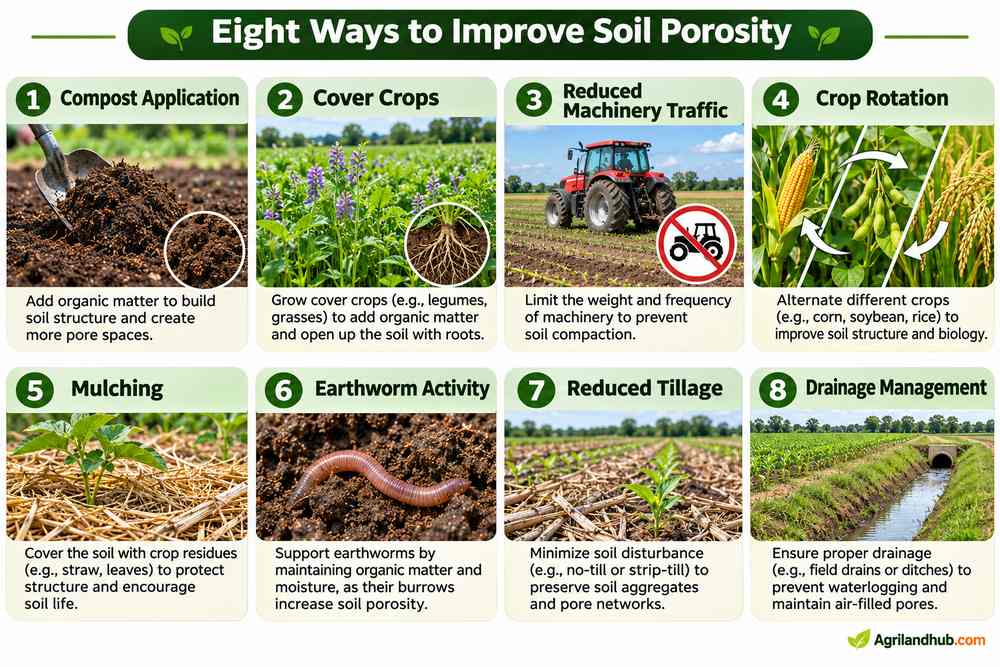
The following techniques can help improve soil physical conditions.
1. Add Organic Matter
Adding organic matter is one of the most useful methods for improving soil structure.
Possible materials include:
- Mature compost.
- Well-decomposed animal manure.
- Leaf mold.
- Crop residues.
- Green manure.
- Other suitable organic amendments.
Organic matter supports microbial activity and contributes to stable soil aggregates.
Over time, these improvements can support better pore development and water movement.
2. Grow Cover Crops
Cover crops protect soil between main cropping seasons.
Their roots create biological channels and contribute organic residues.
Examples include:
- Mucuna.
- Sunn hemp.
- Cowpea.
- Clover.
- Other locally adapted legume and grass species.
Cover crops can also reduce erosion and help maintain soil structure.
3. Reduce Soil Compaction
Soil compaction can significantly reduce large pores.
Farmers can reduce compaction by:
- Limiting heavy machinery traffic.
- Using designated traffic lanes.
- Avoiding field operations when soil is excessively wet.
- Managing livestock access.
- Monitoring compacted soil layers.
Reducing unnecessary traffic is often more effective than repeatedly loosening the soil after compaction has occurred.
4. Practice Crop Rotation
Crop rotation involves growing different crop species in a planned sequence.
Different crops develop different root systems, which can influence soil structure and pore development.
Deep-rooted crops may help create channels through compacted layers, depending on soil conditions and the severity of compaction.
Leguminous crops can also contribute organic residues and biological nitrogen fixation.
5. Maintain Soil Surface Cover
Mulching protects the soil surface from direct rainfall impact.
Suitable mulch materials include:
- Rice straw.
- Dry leaves.
- Grass residues.
- Crop residues.
- Organic mulch.
Mulching helps reduce surface crusting, erosion, and rapid moisture loss.
It can indirectly support the maintenance of soil porosity by protecting the surface structure.
6. Encourage Earthworm Activity
Earthworms contribute to soil aggregation and create channels through the soil profile.
Their activity can improve water infiltration and aeration.
To support earthworms:
- Maintain organic residues.
- Reduce unnecessary soil disturbance.
- Avoid excessive soil compaction.
- Maintain suitable soil moisture.
- Use pesticides responsibly.
7. Avoid Excessive Tillage
Intensive tillage may temporarily increase the volume of pore spaces by loosening soil.
However, repeated disturbance can break down aggregates, accelerate organic matter decomposition, and increase the risk of surface sealing or compaction.
Reduced tillage and other conservation practices can help preserve soil structure.
8. Improve Drainage Where Necessary
Poor drainage can cause prolonged saturation and reduce air-filled porosity.
Depending on the field conditions, drainage improvements may include:
- Surface drainage channels.
- Appropriate land leveling.
- Subsurface drainage systems.
- Raised planting beds.
- Improved water management.
Drainage solutions should be designed according to soil texture, topography, water table conditions, and crop requirements.
How to Identify Poor Soil Porosity in the Field
Farmers do not always need laboratory equipment to recognize possible soil porosity problems.
Several field observations can provide early indications that soil structure and pore distribution may be unsuitable for plant growth.
1. Water Accumulation on the Soil Surface
If water remains on the soil surface for a long time after rainfall or irrigation, it may indicate poor infiltration or drainage.
Possible causes include:
- Soil compaction.
- Surface crust formation.
- Poor soil aggregation.
- High clay content.
- Inadequate drainage.
However, standing water can also result from topography, a shallow water table, or excessive irrigation.
2. Hard and Dense Soil
Compacted soil often feels hard and offers resistance when farmers insert a soil probe or digging tool.
This condition may indicate reduced macroporosity and increased mechanical resistance.
It can restrict root penetration and reduce water movement.
3. Poor Root Development
Plants growing in compacted soil may develop shallow or poorly distributed root systems.
Roots may grow horizontally instead of penetrating deeper soil layers.
This can limit access to water and nutrients during dry periods.
4. Poor Soil Aeration
Poorly aerated soil may develop unpleasant odors under prolonged waterlogged conditions.
Plant roots may become discolored, weak, or damaged.
These symptoms can also be associated with root diseases and other soil problems, so additional observations may be necessary.
5. Uneven Plant Growth
Differences in soil structure and porosity across a field can contribute to uneven crop development.
Some areas may experience poor drainage, while others may dry out quickly.
Farmers should compare soil conditions with plant growth patterns to identify potential problem areas.
Relationship Between Soil Porosity and Other Soil Physical Properties
Soil porosity does not function independently. It interacts with several other soil physical properties that influence agricultural productivity.
1. Soil Porosity and Bulk Density
Bulk density and total porosity are inversely related when particle density is constant.
When bulk density increases, total porosity generally decreases.
This relationship makes bulk density a useful indicator for assessing soil compaction.
However, bulk density values must be interpreted according to soil texture and organic matter content.
2. Soil Porosity and Particle Density
Particle density describes the density of the solid soil particles.
It does not include pore spaces.
Mineral soils commonly have a particle density close to 2.65 g/cm³, although organic matter and certain minerals can change this value.
Particle density is important when calculating total soil porosity.
3. Soil Porosity and Soil Permeability
Porosity describes the amount of pore space, while permeability describes the ability of a material to transmit water.
A soil may have high total porosity but low permeability if its pores are poorly connected.
Large and continuous pores generally contribute significantly to water transmission.
4. Soil Porosity and Water-Holding Capacity
Water-holding capacity refers to the ability of soil to retain water.
Small and intermediate pores generally retain water more strongly than large pores.
The amount of water available to plants depends on pore-size distribution and how tightly water is held.
Therefore, high total porosity does not automatically mean high plant-available water.
5. Soil Porosity and Infiltration Rate
Infiltration rate measures how quickly water enters the soil surface.
Continuous macropores can increase infiltration, while surface compaction and crusting can reduce it.
Soil structure and pore connectivity are important factors determining infiltration behavior.
6. Soil Porosity and Soil Aeration
Soil aeration refers to the movement and exchange of gases within soil pores.
When pores contain sufficient air, oxygen can reach plant roots and soil microorganisms.
When most pores become filled with water, oxygen movement becomes restricted.
These relationships demonstrate why soil porosity is an important indicator of soil physical health.
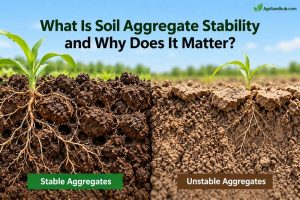
Read Also : What Is Soil Aggregate Stability and Why Does It Matter?
The Importance of Soil Porosity for Different Agricultural Crops
Different crops have different root systems and environmental requirements. Therefore, the importance of soil porosity may vary depending on the crop being cultivated.
1. Rice
Rice is commonly cultivated under flooded conditions in many agricultural systems.
Although rice can tolerate flooded soil better than many other crops, healthy root development still depends on suitable soil physical conditions.
Soil porosity influences:
- Water movement.
- Root-zone aeration.
- Soil redox conditions.
- Nutrient availability.
- Root distribution.
Water management should be adjusted according to the rice cultivation system and growth stage.
2. Corn
Corn requires sufficient soil aeration and moisture for healthy root development.
Poor soil porosity can cause waterlogging and restrict root growth.
Well-structured soil helps roots explore deeper layers and obtain water and nutrients.
3. Oil Palm
Oil palm requires suitable soil physical conditions to support root development and nutrient absorption.
Poor drainage and severe compaction can limit root growth and affect nutrient uptake.
Maintaining organic matter, reducing excessive machinery traffic, and managing drainage are important practices in oil palm plantations.
4. Soybeans
Soybeans benefit from well-structured soil that supports root development and biological nitrogen fixation.
Root nodules depend on suitable biological and oxygen conditions.
Excessive waterlogging can interfere with root respiration and nodule activity.
5. Vegetables
Many vegetable crops have relatively sensitive root systems.
Suitable soil porosity supports:
- Rapid root establishment.
- Consistent moisture availability.
- Better oxygen supply.
- Nutrient absorption.
- Healthy crop development.
Raised beds, compost application, and appropriate irrigation can help maintain favorable soil conditions.
Common Misconceptions About Soil Porosity
Several misunderstandings can lead to incorrect soil management decisions.
1. Higher Total Porosity Always Means Better Soil
This is not necessarily true.
Soil with very high total porosity may still have poor plant-available water or an unfavorable distribution of pore sizes.
The balance between macropores, mesopores, and micropores is important.
2. Sandy Soil Always Has Higher Porosity
Sandy soil generally has larger average pores, but it does not necessarily have higher total porosity.
Clay soil can have higher total porosity because its numerous small particles create many small pore spaces.
3. Soil Porosity and Permeability Are the Same
They are different properties.
Porosity measures the proportion of pore space, while permeability measures how easily water moves through connected pores.
4. Adding More Water Improves Soil Porosity
Water does not automatically improve soil porosity.
Excessive irrigation can fill pore spaces with water, reducing oxygen availability and potentially causing waterlogging.
5. Tillage Always Improves Soil Porosity
Tillage may temporarily loosen soil, but excessive tillage can damage aggregates and contribute to structural deterioration.
Long-term soil management should focus on maintaining stable soil structure rather than relying exclusively on mechanical loosening.
Practical Recommendations for Farmers
Understanding soil porosity is useful, but applying that knowledge in the field is even more important.
Farmers can use the following recommendations to maintain suitable soil physical conditions:
- Test soil physical properties: Measure bulk density and assess soil structure periodically.
- Maintain organic matter: Apply mature compost, suitable manure, and crop residues.
- Avoid wet-soil traffic: Do not operate heavy machinery when the soil is too wet.
- Use cover crops: Grow suitable cover crops to protect soil and develop biological pore networks.
- Manage irrigation: Avoid excessive irrigation that causes prolonged soil saturation.
- Improve drainage: Address water accumulation based on field conditions.
- Protect soil aggregates: Reduce unnecessary and intensive tillage.
- Monitor root development: Examine root depth and distribution to identify possible compaction.
- Maintain crop diversity: Apply crop rotation to support different root systems and soil biological activity.
- Monitor soil changes: Compare soil conditions over time to evaluate the effectiveness of management practices.
These recommendations should be adapted to local soil conditions, crop requirements, rainfall patterns, and farming systems.
Frequently Asked Questions About Soil Porosity
What Is Soil Porosity in Simple Terms?
Soil porosity is the amount of empty space between and within soil particles. These spaces can contain air or water and are essential for root growth, drainage, and soil aeration.
What Is the Normal Soil Porosity?
Approximately 50% is often used as a general reference for well-balanced mineral soil. However, actual porosity varies depending on soil texture, structure, organic matter, and compaction.
Which Soil Has the Highest Porosity?
Clay soils commonly have higher total porosity than sandy soils. However, they generally contain more small pores and may drain more slowly.
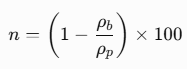
How Is Soil Porosity Calculated?
Soil porosity is commonly calculated using bulk density and particle density:
What Is the Difference Between Macroporosity and Microporosity?
Macroporosity refers to larger pores that support drainage and air movement. Microporosity refers to smaller pores that retain water more strongly.
How Does Soil Compaction Affect Porosity?
Soil compaction presses soil particles closer together, reducing pore space, particularly larger pores. This can restrict water infiltration, aeration, and root penetration.
Can Organic Matter Increase Soil Porosity?
Yes. Organic matter can improve soil aggregation, support biological activity, and contribute to the development of a more favorable pore network.
Why Is Soil Porosity Important for Plant Roots?
Soil porosity provides space for roots to grow and allows water and oxygen to reach the root zone. Appropriate pore distribution supports healthy root development and nutrient uptake.
Conclusion
Soil porosity is an essential physical property that determines how water, air, and nutrients move through the soil and how effectively plant roots develop.
It is influenced by soil texture, structure, organic matter, compaction, moisture, and biological activity. Understanding the differences between macroporosity, mesoporosity, and microporosity helps farmers evaluate soil drainage, water retention, and aeration.
Soil porosity can be calculated using bulk density and particle density, providing useful information about the physical condition of agricultural land.
By maintaining organic matter, reducing compaction, growing cover crops, practicing appropriate tillage, and managing irrigation, farmers can improve soil structure and create more favorable conditions for plant growth.
Ultimately, maintaining balanced soil porosity is an important part of sustainable agriculture and long-term soil productivity.
Read Also : How to Cultivate Rice from Land Preparation to Harvest
References
- Brady, N. C., & Weil, R. R. (2016). The Nature and Properties of Soils. 15th Edition. Pearson Education.
- Hillel, D. (2004). Introduction to Environmental Soil Physics. Elsevier Academic Press.
- Lal, R., & Shukla, M. K. (2004). Principles of Soil Physics. Marcel Dekker, Inc.
- Jury, W. A., & Horton, R. (2004). Soil Physics. 6th Edition. John Wiley & Sons.
- Marshall, T. J., Holmes, J. W., & Rose, C. W. (1996). Soil Physics. 3rd Edition. Cambridge University Press.
- USDA Natural Resources Conservation Service. (2017). Soil Survey Manual. United States Department of Agriculture.
- USDA Natural Resources Conservation Service. (2014). Soil Quality Indicators: Soil Structure and Macropores. United States Department of Agriculture.
- Reynolds, W. D., & Elrick, D. E. (2002). Soil Water Content and Soil Water Potential. In: Soil Physics Companion. CRC Press.
- Schwyter, A. R., & Vaughan, K. L. (2021). Bulk Density, Porosity, Particle Density of Soil. University of Wyoming Open Educational Resources.
- Virginia Cooperative Extension. (2024). Soil and Soil Water Relationships. Virginia Tech.
- Nimmo, J. R., Katuwal, S., & Lucas, M. (2023). Porosity and Pore-Size Distribution. USGS Publications Warehouse.
- Soil Quality Australia. (n.d.). Bulk Density – Measurement. Australian Soil Quality Information.
- Minnesota Pollution Control Agency. (n.d.). Soil Physical Properties and Processes. Minnesota Stormwater Manual.
- Mississippi State University Extension Service. (n.d.). Soil Physical Properties in Healthy Soils. Mississippi State University.
- NSW Department of Primary Industries and Regional Development. (2025). Soil Physics. New South Wales Government.