Healthy soil is essential for productive agriculture, sustainable land management, and long-term environmental protection. Although farmers often focus on soil fertility, pH, and nutrient availability, the physical condition of soil is equally important. One key indicator of physical soil health is soil aggregate stability.
Soil aggregate stability describes the ability of soil aggregates to maintain their structure when exposed to disruptive forces such as rainfall, irrigation, tillage, wind, and physical pressure. Stable aggregates help soil maintain its pore spaces, resist erosion, regulate water movement, and provide favorable conditions for plant roots and soil organisms.
When soil aggregates break apart easily, fine particles can clog soil pores, surface crusts may form, and water may run off instead of infiltrating the ground. These problems can reduce plant establishment, increase erosion, and make agricultural production more vulnerable to drought and heavy rainfall.
Understanding soil aggregate stability allows farmers, agronomists, gardeners, and land managers to recognize changes in soil condition and choose management practices that support long-term productivity. This article explains what soil aggregate stability is, how it develops, why it matters, how to assess it, and which practices can improve it.
What Is Soil Aggregate Stability?
Soil aggregate stability is the ability of soil aggregates to resist breakdown when subjected to physical and environmental forces. These forces include the impact of raindrops, flowing water, wind abrasion, cultivation, and other disturbances.
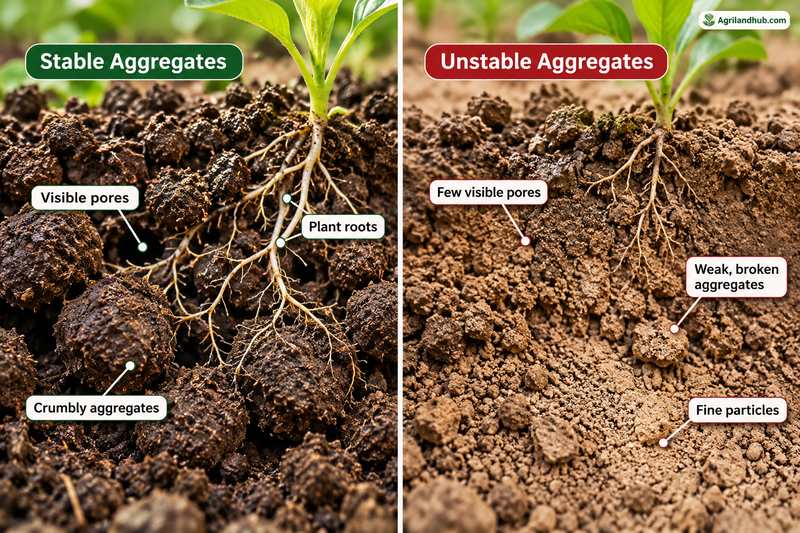
A soil aggregate is a group of individual mineral particles, including sand, silt, and clay, bound together by organic matter, biological substances, mineral interactions, and other binding mechanisms. Instead of existing only as separate particles, soil components form small structural units that influence how water, air, and roots move through the ground.
Aggregates vary in size and shape. Some are microscopic, while others can be seen and handled. Their arrangement creates a network of pores that determines many of the soil’s physical properties.
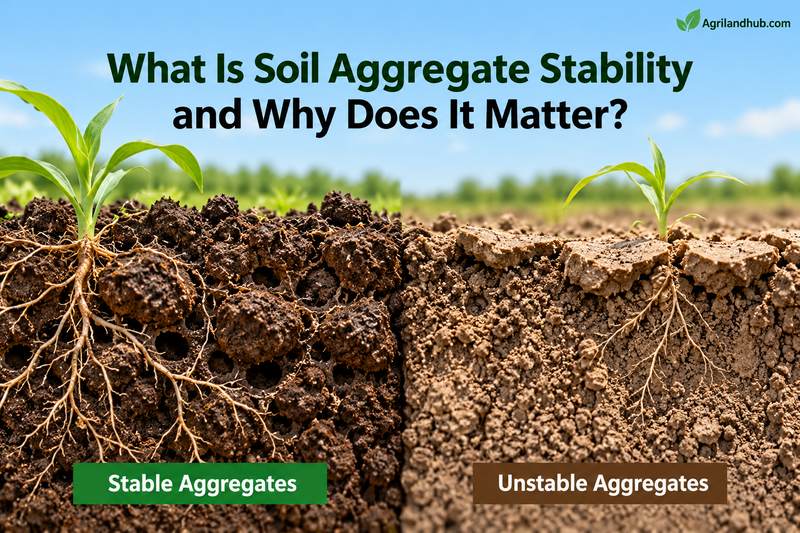
Stable aggregates resist disintegration and help preserve these pores. Unstable aggregates, by contrast, may collapse when exposed to water or mechanical disturbance.
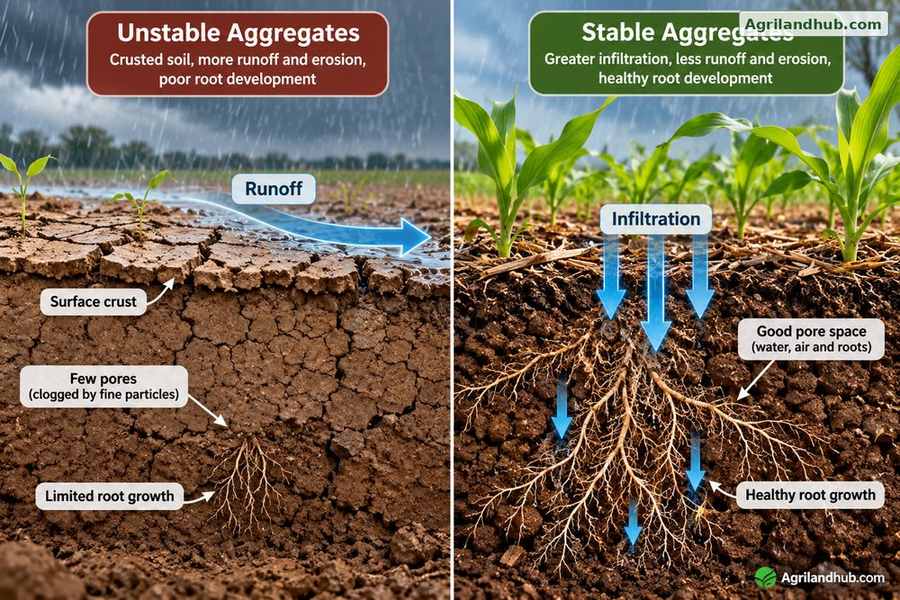
For example, when heavy rain strikes a field with weak aggregates, soil particles can detach and move into surface pores. As the surface dries, the particles may form a hard crust. This crust reduces water infiltration and can make it difficult for seedlings to emerge.
In soil with well-developed, stable aggregates, the structure is more resistant to these processes. Water can enter the soil more readily, roots can explore the ground, and the risk of surface erosion may be reduced.
However, aggregate stability is not identical to soil texture or overall soil fertility. It is a distinct physical property influenced by the interactions among soil particles, organic matter, microorganisms, moisture, and management practices.
How Are Soil Aggregates Formed?
Soil aggregates develop through the interaction of physical, chemical, and biological processes. Their formation is gradual and depends on soil composition, environmental conditions, vegetation, and management.
1. Mineral Particles
Sand, silt, and clay are the primary mineral components of most agricultural soils. These particles differ in size, surface area, and chemical behavior.
Clay particles have a particularly large surface area relative to their mass and can interact strongly with organic compounds and other minerals. Depending on the type of clay and the chemical conditions, these interactions may contribute to aggregation or, under unfavorable conditions, particle dispersion.
The proportions of these particles influence how aggregates form and how well they withstand water and mechanical forces.
For a broader explanation of how mineral particle sizes affect soil behavior, see What Is Soil Texture? Components, Influence, and Classification.
2. Soil Organic Matter
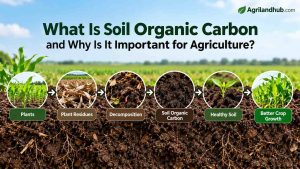
Soil organic matter is one of the major contributors to aggregate formation and stability. Decomposing leaves, crop residues, roots, and other organic materials supply carbon that supports soil microorganisms.
During decomposition, microorganisms produce compounds that help bind soil particles together. Organic matter can also improve the physical environment in which aggregates develop and persist.
The relationship is dynamic. Fresh organic inputs may help form and stabilize larger aggregates, while older organic compounds can contribute to the persistence of smaller structural units.
Soils with appropriate organic matter inputs and biological activity often have better aggregation than comparable soils that have experienced prolonged organic matter depletion.
3. Roots and Fungal Hyphae
Plant roots physically connect soil particles and release compounds into the surrounding soil. These root exudates provide energy for microorganisms and may help bind particles together.
Fungi also contribute to aggregation. Their fine, threadlike structures, called hyphae, can extend through the soil and physically connect particles and aggregates.
Mycorrhizal fungi form associations with plant roots and can contribute to soil structure through their growth and the compounds they produce.
The combined activity of roots, fungi, bacteria, and other soil organisms creates a biological network that supports aggregate development.
4. Soil Fauna
Earthworms and other soil organisms influence aggregation by mixing organic and mineral materials, producing casts, creating channels, and changing the distribution of organic matter.
Earthworm casts can contain concentrated organic and mineral particles bound into aggregates. Their burrows can also improve pathways for water movement and root penetration.
The effects of soil fauna depend on species, soil conditions, and the availability of food and habitat. Nevertheless, maintaining a diverse and active soil biological community is an important component of healthy soil management.
5. Chemical Interactions
Chemical conditions also affect aggregation. Clay mineralogy, soil acidity, salinity, and the balance of exchangeable cations can influence whether particles remain together or disperse.
Calcium and magnesium can help promote aggregation under suitable conditions. In contrast, excessive exchangeable sodium can cause clay dispersion in susceptible soils, weakening structure and reducing infiltration.
These relationships explain why aggregate stability cannot be improved through organic matter management alone in every situation. Some soils may also require careful assessment of salinity, sodicity, drainage, or other chemical constraints.
Why Does Soil Aggregate Stability Matter?
Soil aggregate stability affects several functions that determine agricultural performance and environmental quality. Its importance extends beyond the appearance of the soil surface.
1. It Reduces Soil Erosion
Erosion occurs when soil particles are detached and transported by water or wind. Stable aggregates help protect the soil surface because they are more resistant to breakdown under disruptive forces.
When aggregates remain intact, fewer individual particles become available for transport. A well-aggregated surface can also support better infiltration, reducing the amount of water that flows over the ground.
Weak aggregates are more vulnerable to raindrop impact. Once they disintegrate, fine particles can be carried away by runoff, gradually removing nutrient-rich topsoil.
The consequences include reduced soil depth, loss of organic matter, sedimentation in waterways, and declining agricultural productivity.
Aggregate stability is not the only factor controlling erosion. Slope, rainfall intensity, soil cover, drainage, and land management also matter. However, stable aggregates are an important part of an erosion-resistant soil system.
2. It Improves Water Infiltration
Water infiltration is the process by which water enters the soil surface. It determines how much rainfall or irrigation can move into the root zone instead of running off the field.
Stable aggregates help preserve pores between and within structural units. Larger connected pores can provide pathways for water to move downward, while smaller pores contribute to water retention.
When aggregates collapse, fine particles may block surface pores. A crust can then form, restricting further infiltration.
This problem is particularly important in fields exposed to intense rainfall, bare soil, repeated disturbance, or irrigation that breaks down weak aggregates.
Improving aggregate stability can support more effective use of rainfall and irrigation water, although actual infiltration rates also depend on compaction, soil texture, pore connectivity, and antecedent moisture.
3. It Supports Soil Water Availability
Soil water availability depends on the balance between drainage, water retention, evaporation, and plant uptake.
A healthy aggregate structure helps create a useful distribution of pore sizes. Large pores allow drainage and aeration, while smaller pores retain water against gravity.
This structure can help plants access water between rainfall or irrigation events. It may also reduce runoff losses during heavy rain.
However, greater aggregate stability does not automatically mean that every soil will hold more plant-available water. Sandy soils, clay-rich soils, and loams have different pore characteristics and water-retention behavior.
The goal is to maintain a structure that allows water to infiltrate, drain, and remain available to plants in a balanced way.
4. It Encourages Root Growth
Plant roots need a combination of water, oxygen, nutrients, and physical space to grow.
Stable aggregates help preserve pores and channels that roots can use to penetrate the soil. They can also reduce the formation of hard surface crusts that interfere with seedling establishment.
When soil structure deteriorates, roots may encounter dense layers, restricted aeration, or uneven water distribution. Root systems can become shallow or concentrated in limited parts of the soil profile.
Good aggregation does not eliminate every root-growth problem, especially when compaction or poor drainage is present. Nevertheless, it contributes to a more favorable physical environment for root development.
5. It Supports Soil Aeration
Plant roots and aerobic microorganisms require oxygen for respiration and normal biological activity.
The pore spaces associated with soil aggregates allow air to enter and move through the soil. When water fills most of these pores for extended periods, oxygen availability declines.
Poor aggregation can contribute to surface sealing and an unfavorable pore distribution. Combined with compaction or excessive water, this can limit gas exchange.
Maintaining stable aggregates helps preserve the physical pathways required for soil aeration, although drainage and pore connectivity remain equally important.
6. It Helps Maintain Nutrient Cycling
Soil aggregates influence the movement of water, dissolved nutrients, and microorganisms. They also create different microenvironments where organic matter decomposes at different rates.
Some organic compounds and nutrients may be physically protected within aggregates, limiting their immediate exposure to microbial decomposition. Other organic materials remain accessible and contribute to active nutrient cycling.
This balance affects how carbon and nutrients are stored, transformed, and released over time.
Aggregate stability should not be treated as a direct measurement of soil fertility. A soil may have stable aggregates but still lack essential nutrients. Soil testing remains necessary to evaluate pH, nutrient availability, and other chemical properties.
7. It Helps Protect Soil Organic Carbon
Soil organic carbon is an important component of soil organic matter. Some carbon can become physically protected within aggregates, where contact with decomposing organisms and enzymes may be limited.
When aggregates break apart, previously protected organic material may become more accessible to decomposition.
The relationship between aggregation and carbon storage is complex. Carbon persistence also depends on mineral composition, climate, moisture, temperature, and the continuous supply of organic inputs.
Even so, management practices that support both organic matter accumulation and stable aggregation can contribute to healthier soil and more resilient agricultural systems.
8. It Improves Seedling Establishment
A hard soil crust can prevent small seeds and young shoots from reaching the surface. This may lead to uneven crop emergence and poor plant populations.
Crusting commonly develops when weak aggregates break apart under rainfall or irrigation, allowing fine particles to settle and seal the surface.
Stable aggregates help preserve a more favorable seedbed, particularly when combined with suitable seed placement, soil cover, and careful irrigation management.
What Factors Affect Soil Aggregate Stability?
Aggregate stability is influenced by both relatively permanent soil characteristics and properties that can change through management.
1. Soil Texture and Clay Mineralogy
The proportions of sand, silt, and clay affect the formation of aggregates and the movement of water through soil.
Clay mineral types also differ in their swelling, shrinking, and chemical interactions. Some clay-rich soils develop strong aggregates under suitable conditions, while others are vulnerable to dispersion or structural change.
Sandy soils may have less aggregation because their particles have limited cohesion, but their large pores can still allow rapid water movement.
Consequently, aggregate stability should be interpreted in the context of the soil’s texture and mineral composition rather than through a single universal standard.
2. Organic Matter Content
Organic matter supplies the energy and materials needed for many aggregation processes.
Fields that regularly receive crop residues, compost, or other appropriate organic inputs may develop improved aggregation over time. Conversely, prolonged removal of residues and depletion of soil organic matter can weaken the biological and chemical processes that support soil structure.
The type, quality, quantity, and placement of organic materials all influence the results.
3. Tillage Intensity
Tillage can break apart existing aggregates, disrupt fungal hyphae, expose protected organic matter, and accelerate decomposition.
Repeated intensive tillage may therefore reduce aggregate stability, particularly when combined with low residue inputs and periods of bare soil.
Reduced tillage or no-till systems can help preserve existing aggregates by minimizing mechanical disturbance. However, outcomes depend on soil type, crop rotation, traffic, drainage, and how the system is managed.
Reduced tillage is not a universal solution to every soil problem. Some fields may require targeted mechanical intervention to address specific constraints, followed by practices that prevent the problem from returning.
4. Vegetation and Crop Residues
Living plants protect the soil surface from direct raindrop impact and supply organic matter through roots and residues.
Cover crops, perennial vegetation, and diverse crop rotations can maintain root activity during periods when the main crop is absent. Their roots and associated microorganisms contribute to aggregation, while surface residues reduce exposure to wind and rainfall.
Removing or burning residues, leaving large areas bare, and allowing repeated erosion can reduce these benefits.
5. Soil Moisture
Wet and dry conditions influence how aggregates respond to disturbance.
Some dry soil clods appear strong but break apart rapidly when immersed in water. This is why dry strength alone does not reliably indicate wet aggregate stability.
Rapid wetting can compress trapped air or cause other stresses within aggregates, while clay swelling and chemical dispersion can contribute to breakdown in susceptible soils.
The relationship between moisture and stability varies with soil properties and the method used to assess it.
6. Compaction and Field Traffic
Heavy machinery, repeated passes, and livestock trampling can compress soil, especially when it is wet.
Compaction reduces pore space and can interfere with water infiltration, aeration, and root penetration. Traffic may also damage the structure of the surface layer.
Although compaction and aggregate instability are different properties, they often interact and can contribute to declining soil physical health.
Managing traffic patterns, avoiding unnecessary passes, and limiting heavy operations on wet soil can help protect soil structure.
7. Rainfall and Irrigation Intensity
Intense rainfall can detach particles, break weak aggregates, and transport sediment across the field.
Irrigation can have similar effects if water is applied too rapidly or with enough force to destabilize the surface.
The risk depends on aggregate stability, soil cover, surface slope, soil texture, rainfall intensity, and the condition of the soil before wetting.
Maintaining plant cover and adjusting irrigation methods to local conditions can reduce these pressures.
8. Soil Chemistry
Soil pH, salinity, sodicity, and exchangeable cations influence the interaction between clay particles and organic matter.
Excessive sodium can promote clay dispersion in susceptible soils. Dispersed particles may block pores, decrease infiltration, and weaken the soil surface.
Where sodicity or salinity is suspected, management should be based on soil and water testing. The appropriate treatment depends on the actual chemical problem, drainage conditions, and local recommendations.
How Can Soil Aggregate Stability Be Measured?
Aggregate stability can be assessed through field observations and laboratory tests. Each method provides different information, so results should be interpreted according to the method, soil type, and management history.
1. Visual Soil Assessment
Visual assessment is a useful starting point for farmers and land managers.
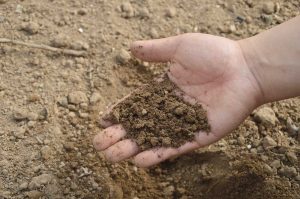
Dig into the soil using a spade and examine a sample from the cultivated or biologically active layer. Look for rounded crumbs, visible pores, fine roots, and aggregates that retain their shape when handled gently.
Also note warning signs, including:
- A hard, sealed surface after rainfall.
- Fine particles that form a crust when dry.
- Large, dense clods that are difficult for roots to penetrate.
- Few visible pores or roots.
- Evidence of runoff, rills, or exposed subsoil.
These observations can help identify possible structural problems, but they do not provide a standardized numerical measurement of aggregate stability.
Soil texture, moisture, compaction, and cultivation history should also be considered before drawing conclusions.
2. The Slake Test
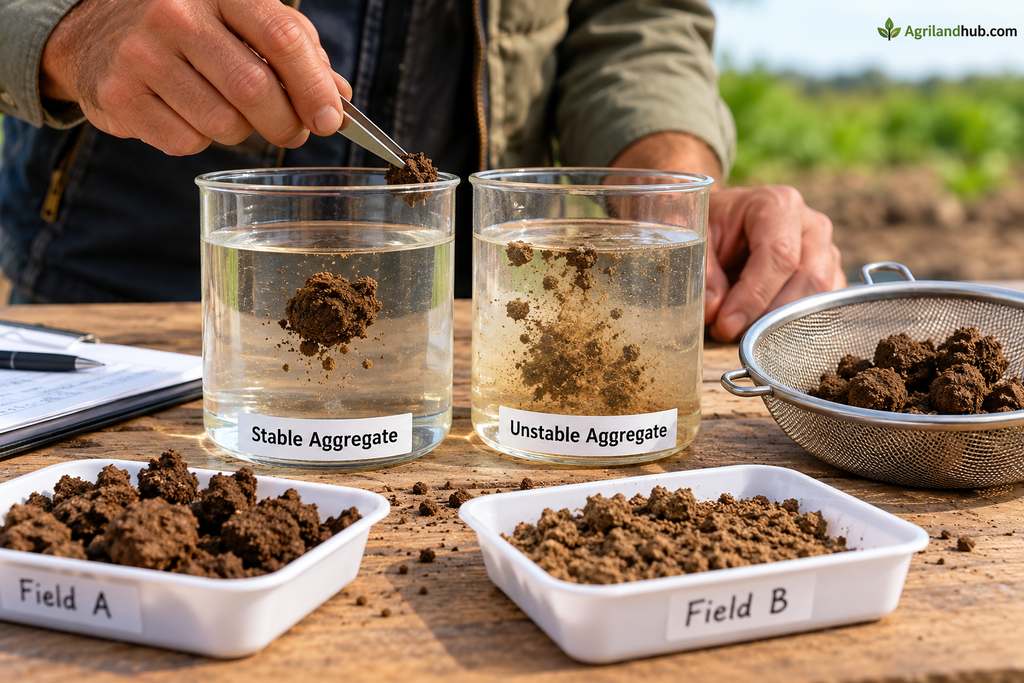
The slake test is a simple method for observing how soil aggregates respond to rapid wetting.
A basic demonstration uses several similarly sized, air-dried aggregates and a transparent container of water. Place each aggregate gently into the water and observe what happens over a consistent period.
Stable aggregates tend to retain more of their original shape, while weak aggregates may crack, collapse, or disperse into smaller particles.
For a meaningful comparison, use similar aggregate sizes, the same water volume, and the same observation time. Test several aggregates from each area because soil properties can vary within a field.
The slake test is useful for screening and comparing soil conditions, but it is not a substitute for a standardized laboratory procedure. It also should not be used alone to compare soils with very different textures or mineral properties.
3. Wet Sieving
Wet sieving is a commonly used laboratory method for measuring the resistance of aggregates to breakdown in water.
A known quantity of aggregates is exposed to wetting and mechanical movement using a specified procedure. The material retained on sieves is then measured to determine the proportion of aggregates that remain intact at selected sizes.
Results may be expressed as the percentage of water-stable aggregates or through other indices, depending on the method.
Wet-sieving procedures differ in sample preparation, aggregate size, wetting rate, shaking intensity, and calculation method. Results should therefore be compared only when the methods are sufficiently consistent.
4. Dry Aggregate Stability
Dry aggregate assessments examine the size distribution or resistance of soil aggregates under dry conditions.
These measurements can be useful for understanding resistance to wind erosion and mechanical abrasion. However, dry stability and wet stability describe different responses.
A soil may form hard clods when dry but still disintegrate quickly after rainfall. For this reason, the choice of test should reflect the problem being investigated.
5. Sampling Across a Field
Soil aggregate stability can vary substantially within the same field because of differences in crop cover, machinery traffic, slope, drainage, and organic matter inputs.
A useful sampling plan includes multiple representative locations rather than relying on a single soil clod. Where relevant, compare areas with different management histories, such as cover-cropped and bare sections.
Record the sampling depth, recent weather, soil moisture, crop history, and test method. Repeat assessments at comparable times and under similar conditions when monitoring changes over time.
There is no single aggregate-stability value that defines good soil for every agricultural setting. Interpretation should account for soil texture, land use, measurement procedures, and the purpose of the assessment.
How to Improve Soil Aggregate Stability
Improving aggregate stability generally requires a combination of practices that protect existing soil structure, supply organic matter, support biological activity, and reduce damaging disturbances.
1. Maintain Soil Organic Matter
Regularly returning suitable organic materials to the soil supports microorganisms and the processes involved in aggregate formation.
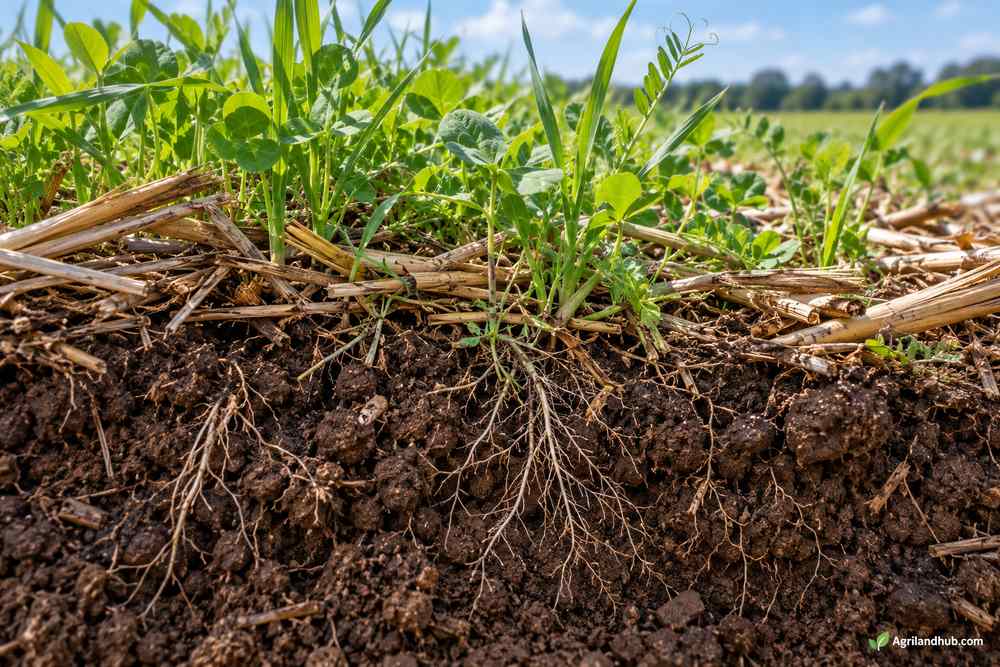
Possible sources include retained crop residues, mature compost, cover-crop biomass, and other locally appropriate organic amendments.
The choice and application rate should reflect crop needs, soil conditions, nutrient content, and local regulations. Organic amendments should not be applied indiscriminately because excessive nutrients, contaminants, or unsuitable materials can create other problems.
Consistent organic matter management is usually more effective as a long-term strategy than a single application.
2. Keep the Soil Covered
Cover crops, mulch, crop residues, and suitable living ground cover protect the surface from direct raindrop impact and reduce exposure to wind.
Cover also helps moderate soil temperature and can reduce evaporation. As plant material decomposes, it contributes organic inputs that support soil biological activity.
Choose cover crops that fit the local climate, crop rotation, available water, and planting calendar. In water-limited environments, cover-crop water use must be considered carefully.
3. Reduce Unnecessary Tillage
Reducing the frequency and intensity of tillage can protect aggregates and preserve fungal networks.
Conservation tillage and no-till practices may improve soil structure over time when combined with suitable residue management, crop rotation, and traffic control.
The transition should be planned around local weed pressure, crop requirements, soil drainage, and available equipment. A change in tillage alone may not solve structural problems if organic matter remains low or machinery continues to compact the soil.
4. Use Diverse Crop Rotations
Crop rotation introduces variation in rooting depth, root architecture, residue quality, and seasonal soil cover.
Deep-rooted crops can explore soil layers that shallow-rooted crops do not reach. Fibrous-rooted crops can create extensive networks near the surface, while legumes may provide additional nitrogen through biological fixation under suitable conditions.
Diverse rotations can also support a broader soil biological community and distribute organic inputs across different parts of the soil profile.
Rotation plans should reflect the production system, disease risks, market opportunities, and local environmental conditions.
5. Manage Machinery Traffic
Machinery traffic should be planned to reduce unnecessary passes and concentrate repeated movement in designated lanes where practical.
Avoid operating heavy equipment when the soil is excessively wet, because wet soil is often more vulnerable to compaction.
Controlled traffic farming, appropriate tire pressure, and equipment matched to field conditions can help reduce the area exposed to repeated loading.
Where compaction already exists, identify its depth and extent before selecting a corrective treatment. Aggressive loosening without changes to traffic management may provide only temporary benefits.
6. Manage Grazing Pressure
In pasture and mixed farming systems, livestock can contribute nutrients and organic matter, but excessive trampling may damage soil structure.
Heavy grazing can also reduce plant cover and increase the size of bare areas, exposing soil to erosion.
Rotational grazing, appropriate stocking rates, adequate recovery periods, and protection of vulnerable wet areas can help maintain vegetation and reduce surface disturbance.
The right approach depends on livestock species, soil moisture, forage growth, and local production goals.
7. Improve Drainage Where Necessary
Prolonged saturation can restrict oxygen availability and increase the vulnerability of some soils to structural damage during traffic or cultivation.
Where poor drainage is a limiting factor, investigate the cause before installing drainage systems or changing irrigation practices. Surface runoff, shallow water tables, restrictive layers, and irrigation scheduling may require different solutions.
Drainage interventions should be designed for the soil and landscape, with attention to downstream water quality and applicable regulations.
8. Correct Chemical Constraints
Where testing identifies sodicity or another chemical problem affecting soil structure, corrective measures may be needed alongside organic matter management.
For sodic soils, amendments such as gypsum may be appropriate in certain circumstances because calcium can help replace exchangeable sodium. However, effectiveness depends on soil chemistry, amendment requirements, water quality, and adequate drainage to remove displaced sodium.
Gypsum is not a universal soil conditioner and should not be applied solely because the soil is hard or compacted.
Soil and irrigation-water analyses can help determine whether a chemical amendment is justified and which treatment is appropriate.
9. Use Irrigation Carefully
Irrigation should supply water at a rate appropriate for the soil’s infiltration capacity.
Where surface sealing is a problem, consider whether irrigation intensity, droplet impact, or application frequency is contributing to aggregate breakdown. Suitable sprinkler adjustments, drip irrigation, residue cover, or other locally appropriate methods may reduce disturbance.
Avoid prolonged saturation where drainage is poor, and account for crop water requirements and soil moisture conditions when scheduling irrigation.
10. Monitor Progress Over Time
Aggregate stability usually responds to management gradually, although it can also deteriorate rapidly after severe disturbance.
Establish baseline observations and repeat assessments using the same sampling depth, test method, and comparable soil-moisture conditions.
Track additional indicators such as soil organic matter, infiltration, surface crusting, visible erosion, root distribution, and crop establishment. Taken together, these measurements provide a more complete picture of soil physical health than any single indicator.
Soil Aggregate Stability in Sustainable Agriculture
Soil aggregate stability is relevant to many agricultural systems, including annual cropping, orchards, vegetable production, pasture, and agroforestry.
In annual cropping systems, stable aggregates can support seedbed quality, infiltration, and resistance to erosion. Retaining crop residues and diversifying rotations may help maintain structure between growing seasons.
In orchards and other perennial systems, living ground cover between rows can reduce bare-soil exposure and contribute root-derived organic inputs. However, vegetation management must balance soil protection with competition for water and nutrients.
In vegetable production, repeated cultivation and intensive traffic can challenge soil structure. Careful timing of field operations, organic matter management, and suitable cover crops may help limit deterioration.
In pastures, stable soil structure supports infiltration, root growth, and the persistence of productive vegetation. Maintaining plant cover and managing grazing pressure can reduce the risk of bare areas and erosion.
Across all these systems, the objective is not simply to produce the largest possible aggregates. It is to maintain a balanced structure with sufficient stability, connected pores, suitable aeration, and adequate water movement for the intended land use.
Aggregate stability also needs to be considered alongside other soil properties. Soil texture, soil profile characteristics, drainage, compaction, nutrient status, and organic matter each influence how well a field supports plant growth.
Common Misconceptions About Soil Aggregate Stability
Several misunderstandings can lead to incorrect conclusions about soil condition.
Misconception 1: Hard Soil Always Has Stable Aggregates
A hard soil clod may resist pressure when dry but disintegrate rapidly when wet. Hardness can also result from compaction or cementation rather than desirable aggregation.
Wet aggregate testing and field observations provide more useful information than dry hardness alone.
Misconception 2: More Clay Always Means Better Stability
Clay can contribute to aggregation, but the effect depends on mineral type, organic matter, chemical conditions, and management.
Some clay-rich soils have stable structures, while others disperse under unfavorable chemical conditions.
Misconception 3: High Aggregate Stability Guarantees High Fertility
Stable aggregates support several important soil functions, but they do not guarantee that nitrogen, phosphorus, potassium, or other nutrients are available in sufficient quantities.
Soil physical assessment and soil fertility testing answer different questions and should be used together.
Misconception 4: Adding Organic Matter Produces Immediate Results
Organic inputs can support aggregation, but the response depends on decomposition, soil biology, climate, and existing soil conditions.
Consistent management over time is often necessary to produce measurable changes.
Misconception 5: One Test Can Represent an Entire Field
Soil properties vary across landscapes. A sample from one location may not represent areas with different textures, slopes, crop histories, or traffic patterns.
Representative sampling and repeated measurements provide a stronger basis for management decisions.
Conclusion
Soil aggregate stability is a fundamental indicator of soil physical health. It describes the ability of soil aggregates to resist breakdown and helps explain how well the soil can maintain its structure under rainfall, irrigation, wind, and mechanical disturbance.
Stable aggregates contribute to erosion resistance, water infiltration, suitable pore distribution, root development, soil aeration, and organic matter protection. Weak aggregates can break apart, clog surface pores, form crusts, and increase runoff and soil loss.
Aggregate stability is influenced by soil texture, mineralogy, organic matter, biological activity, vegetation, moisture, soil chemistry, tillage, and machinery traffic. Farmers can evaluate it through field observations, slake tests, and laboratory methods such as wet sieving.
Improvement generally requires a long-term approach that combines soil cover, organic matter management, suitable crop rotations, reduced unnecessary disturbance, careful traffic management, and correction of identified soil constraints.
Most importantly, aggregate stability should be assessed as part of a broader soil-health strategy. When combined with soil testing and sound field management, it helps farmers protect productive topsoil, improve the efficiency of water use, and build more resilient agricultural systems.
Sources and References
- Brady, N. C., & Weil, R. R. (2016). The Nature and Properties of Soils (15th ed.). Pearson.
- Bronick, C. J., & Lal, R. (2005). Soil structure and management: A review. Geoderma, 124(1–2), 3–22.
- Chenu, C., & Cosentino, D. (2011). Microbial regulation of soil structural dynamics. In K. Ritz & I. Young (Eds.), The Architecture and Biology of Soils: Life in Inner Space. CABI.
- Dexter, A. R. (1988). Advances in characterization of soil structure. Soil and Tillage Research, 11(3–4), 199–238.
- Elliott, E. T. (1986). Aggregate structure and carbon, nitrogen, and phosphorus in native and cultivated soils. Soil Science Society of America Journal, 50(3), 627–633.
- Franzluebbers, A. J. (2002). Soil organic matter stratification ratio as an indicator of soil quality. Soil and Tillage Research, 66(2), 95–106.
- Hillel, D. (2004). Introduction to Environmental Soil Physics. Elsevier Academic Press.
- Kay, B. D. (1998). Soil structure and organic carbon: A review. In R. Lal et al. (Eds.), Soil Processes and the Carbon Cycle. CRC Press.
- Le Bissonnais, Y. (1996). Aggregate stability and assessment of soil crustability and erodibility: I. Theory and methodology. European Journal of Soil Science, 47(4), 425–437.
- Magdoff, F., & van Es, H. (2021). Building Soils for Better Crops: Ecological Management for Healthy Soils (4th ed.). Sustainable Agriculture Research and Education.
- Oades, J. M. (1984). Soil organic matter and structural stability: Mechanisms and implications for management. Plant and Soil, 76, 319–337.
- Six, J., Elliott, E. T., & Paustian, K. (2000). Soil macroaggregate turnover and microaggregate formation: A mechanism for carbon sequestration under no-tillage agriculture. Soil Biology and Biochemistry, 32(14), 2099–2103.
- Tisdall, J. M., & Oades, J. M. (1982). Organic matter and water-stable aggregates in soils. Journal of Soil Science, 33(2), 141–163.
- USDA Natural Resources Conservation Service. (201 Soil Quality Institute. (2001). Soil Quality Test Kit Guide. United States Department of Agriculture.
- Six, J., Bossuyt, H., Degryze, S., & Denef, K. (2004). A history of research on the link between (micro)aggregates, soil biota, and soil organic matter dynamics. Soil and Tillage Research, 79(1), 7–31.